


The measured energy resolution in dependence of the beam energy can be seen in figure 3.
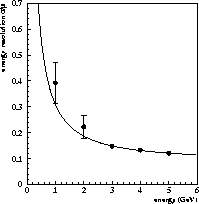
Figure 3: Energy resolution in dependence of the energy.
The line which can be seen in figure 3 is the parameterized energy resolution formula of equation 1. For the fit the sampling term was fixed to the result from the simulation of 12.9 %. Only the noise and constant term are fitted as free varying parameters. The large error bars of the measured points at 1 and 2 GeV originate from large systematic errors at these energies. These are caused by the different efficiencies of noise cuts applied to the data. The result of the fit is:

The noise term of 260 MeV is due to the low noise of the preamplifiers which were already discussed. This is in agreement with the expectation. The large constant term of 9 % is in disagreement with the result from the simulation where it was 3.1 %. This is due to the fact that so far no intercalibration has been applied to the single readout channels. For the energy reconstruction the contents of 20 readout channels are summed. The area in which the electrons hit is 2x2 cm defined by the size of the trigger scintillators in the testbeam. Thus about 30-35 readout channels are involved in the energy reconstuction. All these channels may have different response to the same electron they see. This originates from the channel to channel variations of the optical couplings in the optical components (e.g scintillator-wavelength shifter, wavelength shifter- photodiode). From the difference between the constant term determined by the simulation and by the measurement this inhomogeneity can by quantified by subtracting both numbers in quadrature. This yields to an intercalibration error of the channels of about 8 %. The intercalibration constants have been figured out recently. The result agrees exactly with the value figured out above.
The deviation from linearity of the energy response is found to be less than 1 %.