


The active calorimeter volume is composed of alternating layers of 2.5 mm
thick tungsten plates and 3 mm thick scintillator planes. The whole volume
consists of 24 scintillator planes and 23 tungsten plates. This amounts to a
total length of the active volume of 129.5 mm. The calorimeter depth expressed
in radiation length is 16.7  . The Molière radius is 1.25 cm.
To achieve spatial resolution the scintillator planes are segmented in slabs of 5 mm width. These slabs are alternately arranged in x and y direction. This can be seen in figure 1.
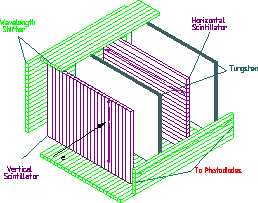
Figure 1: Readout structure of the calorimeter.
Since the active area of the calorimeter has a lateral extension of 124x94 mm 24 slabs are used for the vertical planes and 18 the for horizontal planes. The slabs are wrapped with white paper to prevent crosstalk and to maintain total reflection at the surface of the slabs. A certain fraction of the light produced by the electron shower is thus forced to travel along the slabs by total reflection and emitted at both ends of the slab. At both ends of each scintillator slab there are wavelength shifters absorbing the light emitted from the scintillator slabs. The wavelength shifter absorbs the light emitted by all slabs at the same x or y position of all scintillator planes of the same slab orientation. This yields the integration of all the light in longitudinal direction. The wavelength shifters are glued directly to custom made photodiode arrays with 18 or 24 photodiodes on both ends respectively. Because every slab row is read out at both ends the number of photodiodes amounts to 168 per calorimeter module.
Behind the photodiodes PCB boards carrying the preamplifier chips are mounted on both ends of the active volume of the calorimeter. The longitudinal extension of this readout electronics adds approximately 10 mm on each side to the length of the calorimeter. The housing of the calorimeter adds another 5 mm on each side yielding a total calorimeter length of 160 mm.
The signals of both ends of one wavelength shifter are summed electronically so that the number of electronic readout channels is half the number of photodiodes reading out the calorimeter. This yields 84 electronics channels per module.
This readout structure is able to measure the x and y projection of the shower profile from which the impact point can be reconstructed by calculating the energy weighted center of gravity. The energy of the incident electron is represented by the sum of all readout channels showing a signal above the noise level. Due to the redundancy in the readout the so called single diode or nuclear counter effect can be easily suppressed. This can be done in the spatial as well as in the energy reconstruction.